

Peering Out the Overton Window
Unpacking a salient political science concept and filtering it through our modern Catholic faith in American political life

There’s a political science concept known as the “Overton window.”
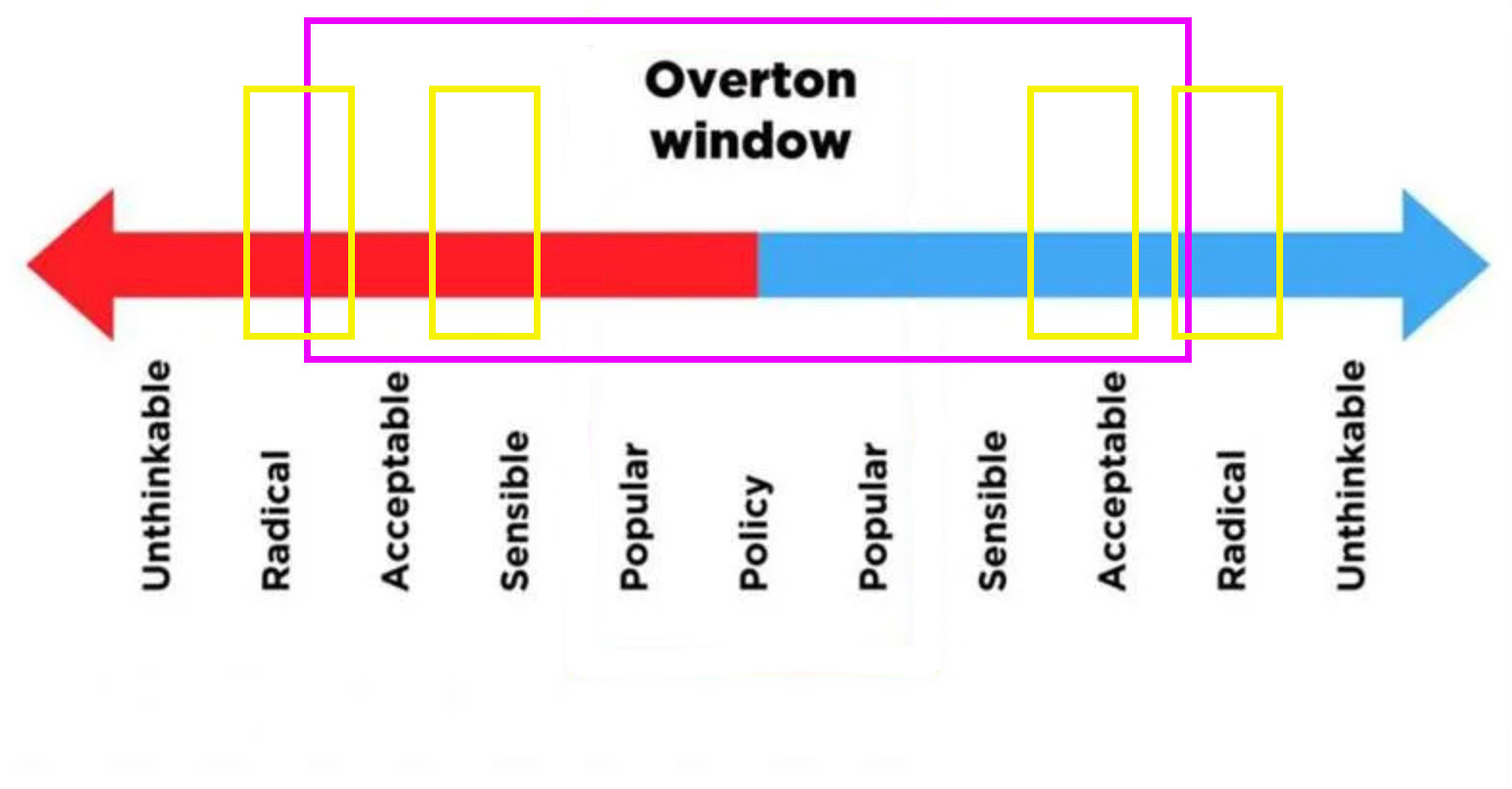
Political ideologies, policies, and positions stretch across a continuum from left to right. In short, the Overton window describes the range on that spectrum that is politically acceptable to the mainstream population, and (at least formerly) often overlaps with the legislation that passes legislatures and is signed by executives with solid public support.
Overton windows can shift for any number of reasons, from relevant recent events to effective political messaging campaigns. And at times, an Overton window can shift so much that a broadly popular policy or spending allotment can become unpopular and face repeal or recission – look no further than rescinded budget appropriations to international aid and public broadcasting, or, conversely, to the growing popularity of the Affordable Care Act over its lifetime and failed attempts at its repeal.
One of the many things that makes me a proud, committed Catholic is that our theology is so coherent and cohesive, built on the absolute truth of a God who revealed God’s self in Scripture and Tradition to the People of God as led by the Holy Spirit. When facing contemporary world issues and new ethical and moral questions – from COVID-19 vaccination development and administration to the ever-evolving landscape of sexual and reproductive rights in the US – our deposit of faith is nimbly ready to inform our just response.
In one sense, there is no Overton window for Catholics: our beliefs and positions are perennial, unchanging, conclusive. Those fundamentally held ideas are firm. So, we may have a range of positions that are acceptable by our teaching, but the range does not and cannot slide either way.
Yet, those of us who teach the faith, who minister on behalf of Christ and the Church, who try to meet people where they are and engage their spirituality in the life of the Church, we, in particular, know there’s more to our beliefs and positions that the face-value of each verse of the bible or the literal reading of each paragraph of our catechism.
My years in high school classrooms, on teens’ retreats, and trying to communicate on behalf of a religious community show me how it takes a range of approaches, a variety of packaging, and unending creativity to try to engage people. It’s not because of any dryness or dullness on the part of Christ, but because the Gospel truth doesn’t always make perfect, immediate sense to people in the context of life’s busyness, injustice, and complexity. Additionally, we, as messengers, bring our own flaws to the effort.
To me, this is where pastoral applications come in.
When my childhood parish could not dedicate a capital campaign to expanding our church, we continued depending on our school gym and its stackable chairs for most Masses. As such, we didn’t kneel for the Eucharistic Prayer and instead stood, with the bishop’s blessing, as sought by our pastor.
When the first school I worked at had not yet built a chapel or instituted a permanent tabernacle, we would try our best to put out as few hosts as possible for each gym Mass. Then we’d piously and respectfully consume the remainder, lacking a proper place to reserve the consecrated hosts.
When a few teenaged students at the PreK-12 school where I worked wanted to do Confirmation, having already been baptized and received First Communion, rather than bundling them with 8th graders, our pastor allowed the youth minister and me to build a mini-cohort of teens and form them with slightly more age-appropriate preparation than they might have gotten with middle schoolers or RCIA adults.
These are a few small ways that I’ve seen local ministry leaders strive to keep to the full spirit of our norms, practices, and beliefs and nonetheless meet people where they are bring them to Christ and Christ to them as best we could.
We also see it in the broader Church, often in ways that are more profound and trickier.
I think of Pope Francis and Fiducia Supplicans, where he laid out the manner in which an ordained person can bless a same-sex couple – that is, outside of Mass and not concurrent with any marriage ceremony and yet necessitating some exhaustive moral evaluation of someone requesting a blessing. This did not change Church teaching on homosexuality or marriage between same-sex partners; it did change the norms of acceptance and ministry to them and for them. (Here’s one reflection from a Catholic who is gay.)
I think now also of Bishop Alberto Rojas of the Diocese of San Bernardino (where I actually lived for one year) dispensing the faithful from their Sunday obligation temporarily – for fear that over-the-top immigration raids and enforcement actions would target Catholic places of worship, where many Latino/Hispanic faithful would surely be heading dutifully to fulfill their Sunday obligations. And I think of Archbishop Jose Gomez of the Archdiocese of Los Angeles encouraging parishes to enhance their pastoral care and faith formation in people’s homes, if they are perhaps staying home from religious education and fellowship gatherings at their parishes. This did not dilute the Sunday obligation or culture of faith formation but honored the unusual, difficult realities for the faithful.
I think of Catholic schools and parishes who employ faculty and staff who are gay and who minister in a way that does not scandalize the Church. When these brothers and sisters simply come to work to serve the people of God –and especially when they take no public position or give no public voice to any dissent they may have toward Church teaching, beyond the simple fact of their identity – Catholic organizations ought to sustain and relish their employment.
And more and more questions will arise. Now that abortion is not a federally protected right, how do we treat women whose lives are in danger due to pregnancy complications? As more people come out as transgender, how do we address laws that alternatively restrict or enshrine the right to treatments such as hormone therapies and gender-related surgeries? Now that Pope Francis has clarified that the modern world should have no death penalty, how do we finish eradicating it from the US justice system?

In some areas, the response has already emerged and feels sound; in others, there’s yet immense work to do. Indeed, for our Church, the Overton window may be anchored in firm, unchanging teaching yet encompass a wide range of pastoral practice.
Catholics can reasonably be for tighter border security or for more liberal immigration policy – or for some combination of the those two. However, we cannot support the omission of due process or condone unmarked, unbadged strike teams. We uphold the dignity of all people and the secure sovereignty of our nation.
Catholics can reasonably desire more protectionist trade policy with international partners that nurtures robust domestic economies or favor more open, free international trade – or some mix of the two. However, we cannot support unbridled capitalism with total disregard for the environment or an ever widening rich-poor gap. We uphold a just economy where everyone can earn a living, just wage and gain stability.
Catholics can reasonably prefer private enterprise in news, broadcast, and information or prefer publicly subsidized broadcasting – or some combination of the two. However, we cannot support the rejection of inconvenient facts, undermine the place of the government in providing reliable, robust public data, or ignore the greater need among rural and Indigenous communities for publicly subsidized communications. We uphold a society in which elected officials and civil servants are conscious of their constituents and the common good.
For Catholics, our disconnect with the concept of a “sliding” Overton window is that while our belief must manifest and live in a real world with subjective, evolving contexts, our belief precedes all of that, unchanging, and can only adapt partly and pastorally.
Our political leanings and affiliations – or our lacks thereof! – can shift and slide as we see fit, but that’s only an application of our foundation: the primacy the person of Christ, the Gospel, and Catholic Social Teaching cannot be subordinated to any party, candidate, or movement, and indeed have never fit neatly with any one politician, movement, party, or era.
As the norm of the Johnson Amendment dissolves, and places of worship are free to endorse candidates and parties without jeopardizing their tax-exempt status, I don’t imagine much, if anything, will change for most of our Catholic churches. A few priests here or there will make the near-endorsements of certain politicians or parties they’ve likely always made; the vast majority of churches and homilists will hold to the truths that rest unchanging under these sliding windows of policy and opinion. Homilists can and should uphold the dignity and value of human life, from conception to natural death, in any and all homilies, especially when connecting it to the readings of the day and the good news therein.
God became human, walked this earth, and modeled complete humanity for us in the freedom and love of Christ. In this enfleshed human dignity, solidarity, and preferential option for marginalized people, we gain our fundamental foundation for life as social beings and children of God. Sliding opinions and contexts may change; our pastoral applications may evolve; our God and our truth is unchanging.
Okay but how do we get the Catholics worshipping politics to read this...